
Building power for progress: A reflection on the Measure A campaign
The day after the June 2nd election on Measure A, when only the votes from early voters had been tallied, the Wednesday morning quarterbacks emerged to proclaim that city voters never really wanted the measure that would have created more homes and more revenue for San Diego. An analysis of the later votes tells a different story — a story of voters who better reflect the diversity of the city and are ready to move progressive solutions forward. But that will take building more people power.
Measure A was a hard-fought campaign with limited resources. As one of the leaders of the campaign, Alliance San Diego Mobilization Fund was invested in its success. Our team and the community we walk alongside know what it means to struggle to find housing and build a life in the city we love. Measure A was a solution. It would have increased the availability of housing and also increased revenue to fund city services and programs that are constantly in threat of being stripped away from our neighborhoods.
With less than 10 weeks to run a campaign, we reached out to individual donors and labor unions for big and small donations and raised just over $300,000. The opposition brought in more than four times that, mostly from the California Realtors Association, whose aim was to protect corporate owners and investors who are buying up homes and keeping them empty in the middle of a housing shortage. They used their money to sow fear and spread lies. This was not a fair fight, and it came as no surprise that the first round of votes on June 2nd leaned against Measure A.
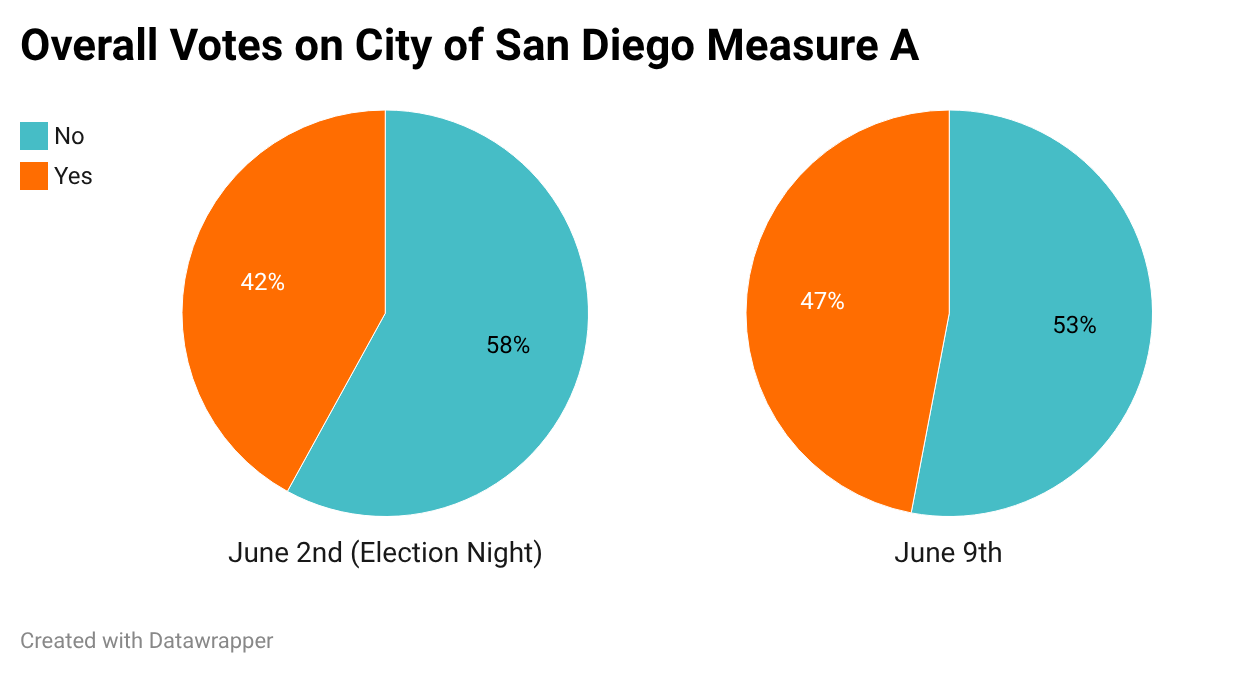
But support rose thereafter. From June 2nd, to June 9th, one week later, the tally of Yes votes rose 5 points to 47%. Although this was not enough to win, the increase is notable and was fueled by the voters who cast their ballots later in the election period. These voters were younger, more diverse, and more representative of the city as a whole.
With each new batch of ballots counted after the first tally, support for Measure A grew. In the second batch, support for Measure A was 46%; in the third and fourth batch, support was 50%, and in fifth, sixth and seventh batches, support was 54% in each batch. In the eighth and final batch, support grew to 64%.
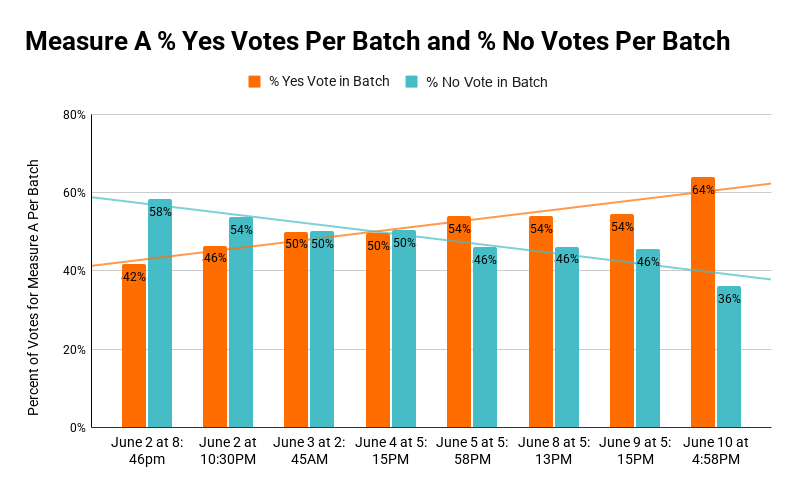
Unfortunately, the later batches were not enough to close the gap, The progression was notable though, and cause for exploration.
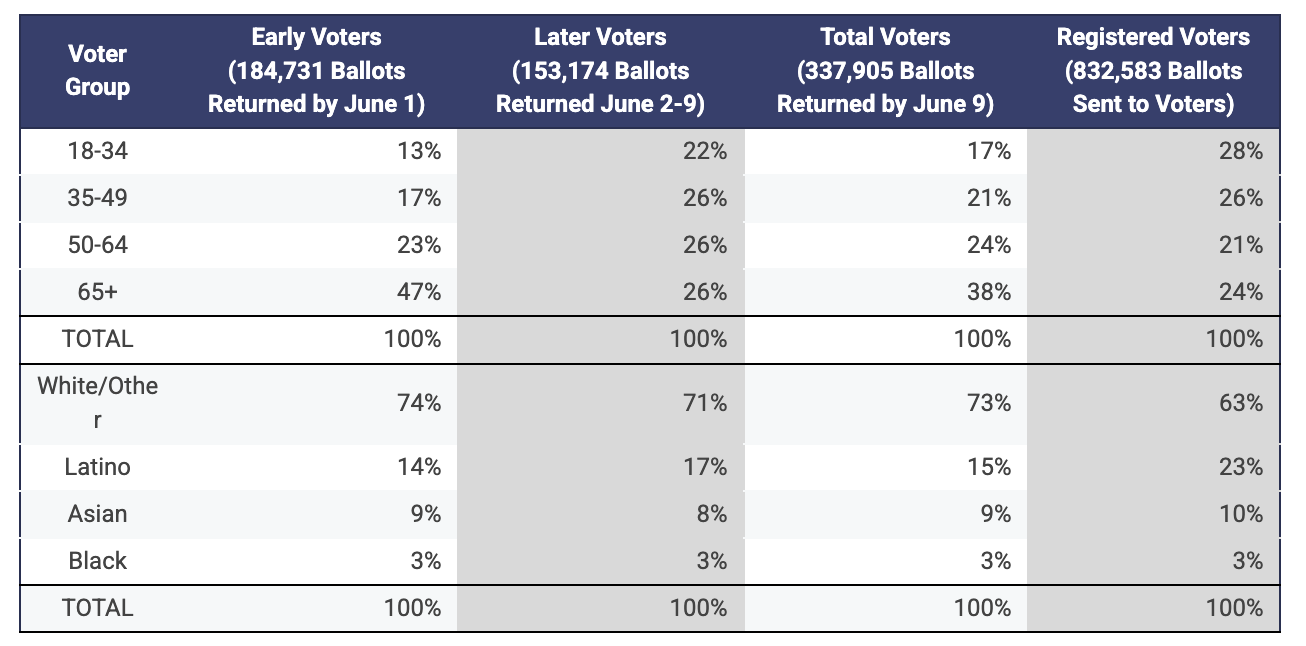
Through the voter data available from PDI, we can see the demographics of the early voters who returned or cast their ballots before election day and the later voters who cast their ballot on or after election day. A review of the data shows us that the later voters were younger and more ethnically diverse, and a better reflection of city voters.
In the end, almost 155,000 voters (47%) said Yes to Measure A. They said Yes to a progressive revenue measure that asks those who can afford second, third, fourth homes to make them available for San Diego families to buy or rent. They said Yes to asking the owners of empty extra homes who choose to keep them vacant to pay their fair share. They said Yes to a future that is focused on ensuring that every family can live and thrive in the city they love.
This gives us hope. Understanding that the voters who reflect the diversity of the city are ready to move progressive solutions forward is a clarion call. It’s a call to think big and move boldly. The campaign itself was a wake up call. What we are doing is not enough (yet) to overcome the influence of monied interests. We must build more power — people power — to rise above those interests that are not only buying up our housing, but also our elections.
We are living in a time when greed is overpowering grace, when profit is prioritized over people, and when housing is viewed as a privilege rather than a human right. We can turn that around.
In the Measure A campaign, our competitive advantage was our ground game — our people. With a team of paid and volunteer canvassers, we knocked on 20,000 doors in working class neighborhoods. We shared information about the ballot measure and countered the lies. The voters we spoke to overwhelmingly supported Measure A, but the scale of our outreach was only a quarter of our original plan because of the lack of resources and the late arrival of those resources. It was not enough. To win, we need to step up our game.
In the absence of more resources, that means more people to talk to their neighbors and amplify the message. With the limited funds we had in the Measure A campaign, we leveraged voter research to identify voters that would most resonate with the measure and turn them out. We had enough funds to run targeted ads, send texts, and support a door-to-door canvass to a select group of voters. The word we did turned out voters, but we need to scale it, and we can, with people like you and me.
This will take getting engaged, all of us, to do our part to build power for progress. It is said that democracy is not a spectator sport, although we often treat elections as such, especially in San Diego. The stakes are too high to sit on the sidelines. We win by getting in the game, throwing the ball, and taking it down the field. Together, as a team. We can do that. We can pull together to build the future we want and elevate our community, claim our dignity, and protect our human rights.
